From a 21-year-old design student at Potsdam. It's not 100% practical. But the idea that revolution (or even evolution) in desktop operating system UIs is going to come not from Apple or Microsoft but from a kid who's been natively dealing with multi-touch screens since they were old enough to drive a car is plausible. The idea that folders are on the way out is already obvious, too.
Building up a portfolio of recorded, mixed work is not always done by traditional routes. That's especially true when your primary selling point as a recordist is mobility. I would probably love to get nothing but mix jobs — the work is fun, solitary, and low-pressure as long as you meet deadlines — but the challenges that take me out of my comfort zone are a big part of what make recording interesting.
The Nouns are a hip-hop and jazz crossover with elements of rock and R&B. They have a level of accessibility that jazz groups don't often achieve, and their talent level is sky-high. Their lineup consists of drums, keys, bass, sax, jazz singer (with some R&B/soul flavor) and an MC.
My strategy would be to mic them up for multi-tracking but not to get too angsty about bleed. They performed in a barely acoustic-treated music classroom at the University for a video shoot.
Challenges
The first unique aspect of this session would be running live sound in a small room while simultaneously recording. The drums didn't need amplification, and the bass and keyboard player both had amps. So I piped everything through my computer in the normal recording chain and produced two separate mixes. I ran a mix of just vocals and saxophone out to three channels of the PA for "house" sound. Then I gave my headphones everything. This worked surprisingly well with Presonus's Universal Control. It enables up to 4 mixes, but it's notoriously crash-happy the more you do with it. Thankfully, it held together enough to give me a 3-channel PA routing while recording all 8 channels of audio.
The bass and keys were easy to record: their amps had DIs and I recorded them direct. I loathe DI'd bass sound most of the time, but a little love from EQ in the mix usually helps and practicality won the day this time.
Mics
For the sax, a Beta 57 positioned a few inches off the bell and at the middle of the horn gave me a surprisingly good sound with minimal effort. I got tonality, articulation, and detailed reediness.
I stuck a pair of SM81s in an XY pattern over the drummer's head. I was able to get them fairly close, given that he's a jazz drummer with little to no arm swing. The XY of course keeps everything in phase, but it turned out to be a great fit for a unique kit. He uses two snares side by side, and no toms. I supplemented the kit with my old Oktava LDC in the front of the kick. The resulting sound has maybe more room sound than I would care for, and the hats are a bit wild on a couple songs, but it serves the musicality and dynamic range of the jazz style playing.
The singers each got an SM7B. This is a mic I had no experience with but I was pleased. Though it's a dynamic, it has a lot of detail and really requires a preamp to pull everything out of it. I put it through my cheapo ART Tube MPA preamp (tube-swapped to minimize noise) and my Symetrix 525 compressor/gate. I only took the biggest peaks off; the SM7B's sound is so smooth, it almost sounds like it's been hit with a compressor already. The MC gave a great delivery, and I cranked the tube preamp to give him a touch of grit. I had so much drum bleed in the singer's mic that even the gate wasn't helping. It's possible I should have switched her to a handheld, but even changing her position in the room may have helped. You live and learn. At the end of the day, though, an LDC would never have worked and an SM58 wouldn't have been very exciting.
Mix
I've been into the idea recently of "console-style" mixing. Initially I tried in the obvious choice, the new (v3) version of [Harrison Mixbus](http://harrisonconsoles.com/site/mixbus.html), but despite some huge improvements in performance it's still not quite ready for primetime. I will continue to experiment with it.
Slate
The "console" mentality proved a great way to justify trying out the new Slate subscription plugin program. While Avid is getting a lot of flak for moving to a subscription based model for all versions of Pro Tools going forward, Steven Slate is proving that execution (and a lot of brand good will going into it) can make all the difference.
The Slate VMR and VCC really tied the sound of all the tracks together, and the 3 EQs (SSL and Neve) and two compressors (Opto and 1176) available in VMR are about what I'd normally use. Since this project wouldn't be mastered, the Slate FG-X would let a non-mastering-engineer like myself put the final touch of volume and polish on the tunes.
Other Plugins
Despite the closeness of the overheads, I feel like the XY pattern gave me a bit too much room sound and the room really wasn't a great one. So I hit them with a bit of Tokyo Dawn's Proxmity plugin, an ingenious combo of reverb, compression, and EQ that can make sources sit closer or farther away in the mix. For the bass, I shamelessly applied Waves Renaissance Axx compression going into the Slate VMR. Surprisingly, I didn't use the Maag EQ4 on the singer. This had a lot to do with the drum bleed throwing unwanted frequencies into her mic; I needed to do more surgery on specific frequencies. The Maag has smart frequencies but they're fixed.
Roundup
This was a challenging recording situation. But with the exception of a few specific issues, the mix came together well. So I might have done something right. More than any other session, Shure saved the day. The Beta 57, far from being a "just good enough" versatile mic, was magic on the sax. And I can understand why the SM7B is such a popular microphone. But the stars of the show were really the SM81s. The simple drum mic setup worked great for jazz, and might make me rethink how I deal with a rock kit next time.
Probably doesn't come as any surprise to anyone that I am, and have been for as long as I can remember, a David Bowie fan. I heard the news early on because I was up late on Sunday night. We all regarded the first tweets skeptically, because people "die" on Twitter all the time and there was a big death hoax with the release of The Next Day. But it was verified sadly by his son, the director Duncan Jones. Suddenly his new album took on a new significance. The lyrics aren't cryptic anymore, just like that. And in roll the thinkpieces and tributes.
It's only in hindsight that I realize what songs like "Rock 'n' Roll Suicide" and "Life on Mars?" did for me as a nerdy, weird, depressed kid. Bowie probably changed my path — for the better.
Somehow the ultimate outsider hero also cut across so many types of people that the response was near-universal. I suppose everyone feels like an outsider, and he managed to tell them "oh no love, you're not alone."
In 2007, I had seen pretty much every Angels of Light or Michael Gira solo tour that had happened since the breakup of Swans. I was pretty burnt my missing the final Swans Are Dead tour so I took every opportunity. Then Gira released a new Angels album with Akron/Family as the backing band. It's all fairly repetitive and hypnotic compared to earlier Angels of Light records, but "Black River Song" in particular kind of exploded my mind when I heard it. Combined with the cover art by Deryk Thomas, who also painted Love of Life and White Light From The Mouth of Infinity covers, it all added up to Swans. I couldn't stop listening to the tune, and probably telling everyone I knew that this meant Swans were coming back.
At the advent of the Swans reboot, Michael Gira repeatedly told a wonderful yarn. Seth of Akron/Family hit a huge chord on stage and it made Gira realize that he wanted more Swans. But when I listen to this tune, I still feel like it was there, dying to get out. And given that he's done what might be his best stuff since the reboot, I'm pretty glad it was.
I haven't really noticed the downside of Sketch on the Mac App Store — except for the reason that I don't have the App Store version. Bohemian couldn't offer a Sketch 3 upgrade to App Store customers, so I got the standard version. Updates come very regularly, and apparently that's one of the major problems they have. I guess this trend has a chance of making Apple change some things. Sketch has to be a decent amount of lost revenue, and maybe more importantly, it's a high-profile Apple Design Award winning app.
Some musical acts who get long in the tooth sustain themselves through constant reinvention, like David Bowie. Others, like Iron Maiden, keep their old hits from sounding tired by pushing themselves to make great new music. And plenty (Springsteen, the Stones) keep flying by on the strength of their live performance regardless of the weakness of their current output. Kraftwerk manage to grab the best parts of all of these by continually refreshing their classic music.
We traveled all the way to Detroit for only a long weekend, and it was basically just to see Kraftwerk. How many more tours do Ralf Hutter and the gang have in them? I don't want to be on the wrong end of that question, having never seen them. Pete told me their shows were boring. Kris told me whatever, the visuals are good and you know all the songs. This is pretty right-on. The visuals, this time in 3D, were a fantastic future-retro mix of graphics and video all completely synced with the tunes.
They started with zero buildup, launching into "Numbers" so fast that much of the theater hadn't gotten seated. They updated the beat that launched a million electro singles into a super powerful, booming dance assault. Apparently Kraftwerk's people enter a venue, evaluate it, and supplement the sound system wherever necessary. And it shows. The sound was powerful but pristine.
The process of updating the songs began with The Mix, but they now sound even better — the beats have The Mix's dancefloor focus but the sounds and synths feel more like ultra-high-fidelity versions of the originals.
Here's a not-great but not-distorted phone clip of "Radioactivity," possibly the most dramatic update.
Ironically, the largest response came for the beginning of the second set, "The Robots." It's ironic because the applause was for the old-school Kraftwerk "robot" mannequins, who took the stage instead of the members. The rest of the time, the group wore uniforms I can only describe as Tron-like, which lit up to correspond with each song's projections.
Overall, a great show and a great classic Detroit venue to see it. It makes an all-day trek with a near-3-year-old just about worth it.
When I was in high school, I had a friend who shrugged off the idea of Wire records after 154, because they "started doing techno or something." That's narrow and inaccurate, but that's how we thought. And anyway, though they used synths the music was more like a left-field pop — and the "p" word is even more damning than "techno."
The inspiration for my friend's comment, though, may have been a "single" that Wire put out during their second phase. The song is "Drill," from The Ideal Copy. It features no less than 9 different reworkings, remixes, and live performances of the song that often bear no resemblance to the original. It's a fun release that hangs alright on its own because the versions are all different. Here's one.
Some of the versions are very industrial in tone, with processed vocals, textures made of samples, heavy programmed beats, and an almost-danceable pulse.
If you knew me at the time I owned the cassette, you were probably subjected to The Drill repeatedly in my Dodge Spirit. I apologize, but only a little.
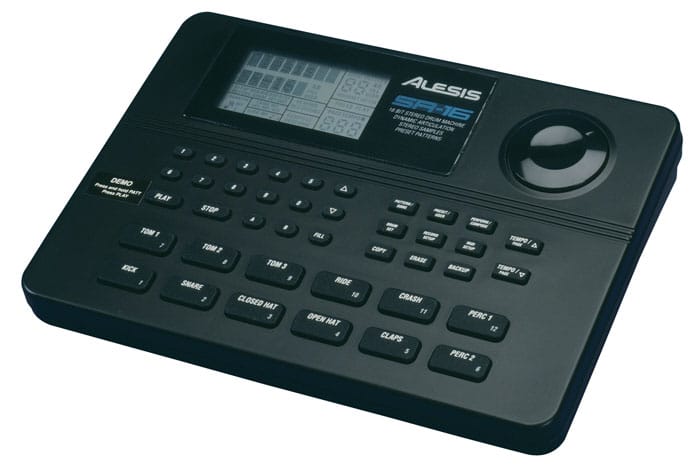
I was somewhat surprised recently to see that some people on the group-buying site Massdrop were attempting to get a group together for the Alesis SR-16 drum machine. At its regular street price, the SR-16 is at the same price point as a lot of other newer, more fashionable machines. The Volca Beats is an insanely fun, great-sounding, compact true analog 808 clone for the same coin. Boss continues to make good drum machines for the same or not much more.
And recently I've been in multiple conversations about how the Alesis brand is mostly garbage. This is a shame, at least for the sake of a few great machines — The Micron/Ion keyboards are among the best synths to come out of the now-passé virtual analog era — but most notably for the SR-16. It's somewhat hard to love, but it's also hard to deny.
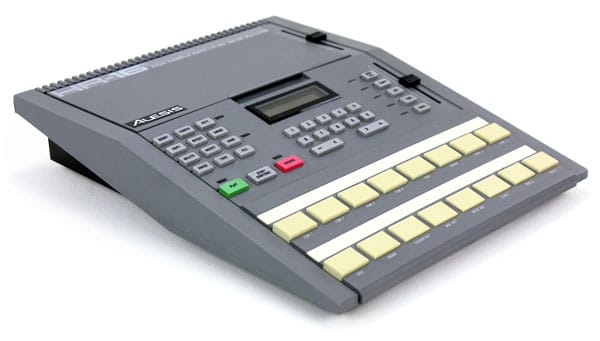
Alesis produced the very first 16-bit sampling drum machine, the HR-16. Previous sample-based machines, like Oberheim's DMX and the Linn LM-1, were 8 or 12-bit. "HR" stood for high resolution and it really wasn't a pose. The samples were good, they had multiple velocity levels, and they were tunable. But there was, as with all machines of the time, a single kit worth of sounds to choose from. I use one, and I replaced the internal chips with Linn LM-1 sounds.
Fast forward to 1993, and the successor to the HR-16 didn't do much for innovation, but it added every feature you might want in a drum machine. There were velocity-dependent samples: if you hit a pad harder you'd hear a sample of a drummer hitting the drum harder, rather than just the same sample at higher volume. There were two drum "fills" for each pattern, so that switching between patterns was less robotic and more realistic. For live standalone users, there were two foot pedal inputs for changing patterns hands-free on stage. But if you wanted to use the unit as a sound module, the MIDI implementation was more complete than anything on the market. Godflesh upgraded their HR-16 to an SR-16, and I started playing fairly Godflesh-like music with one, recording my ideas to 4-track. It also powered my first industrial/experimental band for quite a while before finally giving up the ghost after about 10 years of beats (I still have it and I'm sure it could be made operational again). But as long as it lasted and as useful as it was, I'm surprised that it's still made. More power to it.