All postsEXPLORE TOPIC

#synthesizers

IT'S ALL COMPUTER

It was quite a few years ago that I decided I no longer wanted to deal with computers onstage. It was a dogmatic decision based on fear and some random ideal of musicality, but it was also born from a frustration: I shouldn't have to use computers onstage for the things I wanted to do.

Rewinding a bit, computers had made things so much better. I carted out a desktop and CRT running FruityLoops (now FL Studio) back when MIDI controllers were just piano keyboards, because you could use your computer keyboard to "play" FruityLoops. Then there was Ableton Live, paired with specialized controllers. Suddenly the perpetual issue of how to actually play electronic music on stage rather than just play back, always difficult with traditional sequencers and tons of pre-built effects chains, was solved. Even full improvisation was possible.

But after a brief period of time when computers were both cheap and reliable enough to bring out, it seemed like stuff just kept getting worse. This is, of course, Apple and other manufacturers engaging in Cory Doctorow's famed Enshittification, but if I'm being real it was always in the back of my head. If this thing crashes, I'm fucked. For people with enough money to instantly replace a computer, no biggie. Reinstall the software on a new machine, load up your files from a backup, and you're back on track. After all, you can buy a new Macbook at a Best Buy in likely any place you're going on tour. But if you don't have the means for a new MacBook — which also happens to be the device you do your personal finances, bookmarks, blogging, and day job on — that's a different proposition.

Side note: You can pry my em-dashes from my cold, dead, hands, clanker.

So... after An Empty Room graduated from a two-piece to a slightly more traditional trio, I decided I wasn't gonna do computers anymore. Enter 2025, I look at my setup for SHIVERING, and in the words of a great idiot... IT'S ALL COMPUTER.

How did this happen?

There's the MPC One, which has the form-factor of a classic Roger Linn creation, but also a multi-touch screen, a Linux kernel foundation, and a UI built with KDE's Qt, which Redditors recently discovered bears a strong resemblance to an airline seat-back entertainment interface.

There's our digital mixer, which doesn't even have actual faders, but does have a wifi router.

And there's the MOD Dwarf, a "virtual modular" pedal that I use to create both effects and synth/sample patches that I imagine in my head, and which I strongly suspect is just a literal Raspberry Pi inside a custom German-built enclosure. It's open-source, though!

My Roland SP-404 and Monoprice DMX controller are the only things that don't strongly vibe "wait a minute, isn't this a computer?" and even they're probably just computers.

But I don't look at these things and run, panicked, back to analog synths. They're powerful, flexible, purpose-built, and fun.

Modifying the ban??

So... I guess my computer ban has become a general purpose computer ban.

Almost. I do use an iPad for MIDI-triggered live video, but I'd like to change that someday with another purpose-built (probably Raspberry-Pi-based) machine.

I don't have a point, here. Just finding it funny that I'm still swinging on the hardware-vs-computer pendulum after almost 30 years, but now I'm completely unsure of which side I'm actually on.
Discuss

The Sounds of Jarre

Here's an interesting thing from a few years ago. Comedian and musician Matt Berry interviews Jean-Michel Jarre about the process of creating his 1976 opus Oxygène.

Despite the space-command-center appearance of this hokey promo clip, the central element was actually an organ called an Eminent 310 Unique. He downplays the machine but clearly it was something a bit special, because the string sound was extracted into the ARP Solina a couple years later. Did the success of Oxygène have anything to do with that? Who knows, but maybe. Add the non-programmable Korg Mini Pops drum machine, and you're 90% of the way through creating this iconic record.

The magic happens, though, when he runs the organ through a Revox echo and an Electro-Harmonix Small Stone phaser pedal with a slightly dying battery. Like all EHX pedals, it's not the same these days but they do still make the Small Stone and it's still a great pedal ("Just forget it" says Jarre).

Jarre insists that nobody was running keyboards through guitar pedals at the time. I think that's probably true in his mind, because he's a capital-M Musician. He can play keyboard, and his strong melodies and mini-symphonies are what made such a weird record a mainstream success. But across the channel in the same era, British musicians in the Industrial genre were also running cheap keyboards through guitar pedals to create something far less palatable for the mainstream. Though both used a wide variety of equipment, Chris Carter of Throbbing Gristle and Richard H. Kirk of Cabaret Voltaire would definitely beg to differ that Jarre was the ultimate in synth innovation.

Still, it's a pretty amazing moment when Jarre builds up from the dry keyboard, to the onboard chorus effect, to the Small Stone pedal, to the echo, and suddenly the sound of "Oxygène Part 1" just manifests out of the air. Even on a podcast, Matt Berry's "holy shit" grin is audible.

Discuss

Happy 85th Birthday to Wendy Carlos

Wendy Carlos created soundtracks for Tron, A Clockwork Orange, and many more. She introduced millions to the potential of the synthesizer as a "real" instrument via Switched On Bach. And she even worked with Robert Moog on the development of his legendary synthesizer.

Here she is in a fascinating interview on NOVA in 1989 — height of the DX7's reign, but she explains subtractive synthesis on the classic Moog Modular as well as some amazing additive synthesis on a computer.

Discuss

When you can't be an early adopter

The beta version of the MPC version 3 software is out, and I can't install it because I have shows and can't rely on beta software to not lose all my shit or crash while playing. But oh man, it looks great. On one hand, it does not dispel the notion that modern MPCs are "DAWs in a box," but it also looks more touch-friendly and visible onstage in many ways.

Unfortunately, one of the coolest things (IMO) about the MPC is how the desktop software is sort of an extension — a bigger interface, a plugin host, etc. And until version 3 of that comes out, I have no idea what the experience is going to be like when using the thing in controller mode.

Still... stoked.

Discuss

Apples to MPCs

If you've ever spoken to an electronic musician or a guitarist, you know that GAS (Gear Acquisition Syndrome) is a chronic disease. And though it can be treated, the results tend to be temporary.

The issue, aside from the obvious financial ones, is that gear can never actually solve your problems. That's what all the pros say, anyway, but who can trust them? They have really nice gear.

The real issue, at least as I see it, is that so few pieces of electronic music equipment can be compared in an apples-to-apples sort of way. Guitars? Sure. Tone-chasing is a thing, and a neurosis that's even worse than GAS, because it can cause you to hoard dozens of distortion pedals, claiming they all do different things. But are they all objectively distortion pedals? Yes.

Are a Roland SP-404MKII, an Akai MPC, a Novation Circuit Rhythm, a Korg Electribe Sampler, a Polyend Tracker, and an Elektron Octatrack objectively the same thing? Sort of. They are samplers with sequencing. Most are capable of sequencing external machines via MIDI. Most store samples on an SD card. But it stops there. They range from around $350 to about $1500, and that's not just the honorable Swedish pedigree that's giving Octatrack that kind of price tag. They have varying amounts and quality levels of built-in sounds. There are wide ranges in connectivity and numbers of tracks. Some are more sequencers with sampling capability, others are samplers with just enough sequencing to make you think it's an all-in-one device. Some are very good at both. Some have no screens, some are basically computers in a box. You get the idea.

So, in a live set, to replace Circuit Rhythm and Circuit Tracks with an MPC One is more or less an even trade in terms of whether the same stuff I've been doing is possible. But what else is possible? Turns out, a great deal. More on that another time.

Am I going back on what I say in this post by replacing the Circuits as the centerpiece of live work? Not really, because I'm not thinking of it as an "upgrade." I still think that they are the most beautiful, elegant, and fun quick-composition machines out there, especially the Tracks. But that's not to say that another device doesn't have a place in my show or in my life.

Discuss

In praise (and defense) of the Novation Circuits

Pretty regularly on the Novation Circuit subreddit, a question like this or a comment expressing the same general idea appears. I'm not familiar with any other music gear subs where the users are so often actively trying to get away from their chosen devices.

The Circuit OG/Tracks/Rhythm are very interesting devices. Novation took the success of the Launchpad, an Ableton clip launch controller, and expanded it into a standalone device that really isn't like anything else. There's no screen. The pad grid serves as the user feedback for every function: step sequencing, keyboard, pattern launching, mixing, even the tempo display. That makes it a device that sometimes needs a great deal of memorizing (or RTFM, initially). But it also makes it a device that absolutely nails what it means to be immediate and tactile — attributes that screen-poisoned musicians supposedly crave these days when they step away from the DAW. There's no clicking, no menu diving, no using a scroll wheel to name a pattern. There's you, there's the buttons and knobs, and there's the music. And trust me, it's extremely quick to get to the "music" step. Features of both current-gen Circuits include one-button "scene" launching, sequencer probability and random mutation, pattern chaining for very long variations, and really usable reverb and delay.

So why does everyone think they need to "upgrade" to an Elektron machine, an MPC, or god forbid a Roland MC-707?

Cheap...

Firstly, these things are not expensive. About $350 gets you a new one, and for better or worse this "gotta upgrade" attitude leaves Reverb stocked with them for much less. I think there's an attitude with all kinds of musicians that the more you spend, the better your stuff is. Surprise! That's bullshit. It's not that I'm that old blues lawyer guitarist insisting that "tone is in the fingers" — after all, these same people are connecting 1958 Les Pauls to Dumble amps via Monster cables.

What I mean is electronic musical instruments are very rarely apples-to-apples comparisons. They all have their strengths and their frustrations. And good stuff has never been cheaper than it is right now.

And unspecialized...

The second thing is that, possibly because of said price, no pros have decided that these things have a certain space. If you want to make hard techno or dancey industrial, people like NIN and Richard Devine have sold you on Elektron machines and their hyped, exciter-pumped sounds. If you make lo-fi or boom bap, you want an SP-404 because Madlib, J Dilla, Flying Lotus, and who knows who else used one to make their iconic material. Even doofy gear gets this treatment at times, like the really uninspiring Microkorg being anointed the "synth for an indie rock band that has a synth."

What is the Circuit's space? It doesn't have one. I wouldn't say it's a "master of none" because it's quite good at plenty of things, but looking at it you don't say "ah yes, this thing is for X."

First composition with both Tracks and Rhythm
by u/vrsrsns in novationcircuit

Just like me.

What I can say about the Circuits, especially the Circuit Tracks, is that they are now my centerpiece for both performing and composing, and in 20+ years of making live electronic music I have not owned another machine that enabled my way of working so thoroughly.

Would I like more precise sample cutting onboard? Yeah probably. What about separate outputs? Always want those. But "missing" features like these imply that the very purposeful design of these devices somehow includes more mistakes than it actually does. And the sum of the features versus tradeoffs is unlike anything else out there for both utility and (gasp) fun. So I'm not sure that an upgrade would actually be one at all.

Discuss

RIP Dave Smith

Less than 3 weeks after making an appearance at Superbooth and looking healthy and enthusiastic, Dave Smith is dead at 72.

If you don't know who he is, Smith is a synth pioneer who founded Sequential Circuits in the 70s. They made a lot of iconic synths but were most famous for the Prophet 5, pretty much the first programmable polyphonic synth. It really has yet to be topped, which is probably why the re-built company is still making a Prophet 5.

Then, in the early 80s he conceived of and developed a universal interface for synthesizers from different manufacturers to talk to each other. Whether the fact that it's still in use today is evidence of its effectiveness or of how out-of-date it is now, you can't argue that MIDI is one of the most important things to happen in the world of music since the development of the synthesizer itself. He and Roland founder Ikutaro Kakehashi (also sadly no longer with us) even received a Grammy for the development of MIDI.

For those of us who might never afford a Prophet, MIDI is the great unifier. Since its inception, it has allowed the fanciest Oberheim, the lowliest Volca, your SP-404 loaded with samples of farts, whatever it is, to talk to each other. The standard even continues into the computer, where I can download MIDI files of Clyde Stubblefield playing drums and replace all the hits with sounds of dogs barking or car crashes. I'm sure that's exactly what Smith had in mind.

And speaking of that, one of Smith's other ventures was the first real software synth, Reality. Though he didn't ultimately care for making music inside a computer, it's another project he spearheaded that pretty much changed music forever.

So the only thing left to say is thanks. You'll be missed.

Discuss

I salute you, MMT-8

Few pieces of gear are, on their own, really inspiring. Even the worst gear has its merits, but even the best sounding stuff isn't enough to be a wellspring of creativity. Ableton Live comes to mind, as well as the truly unique Novation Circuit, a cheap groovebox with no screen that I love almost as much as a family pet.

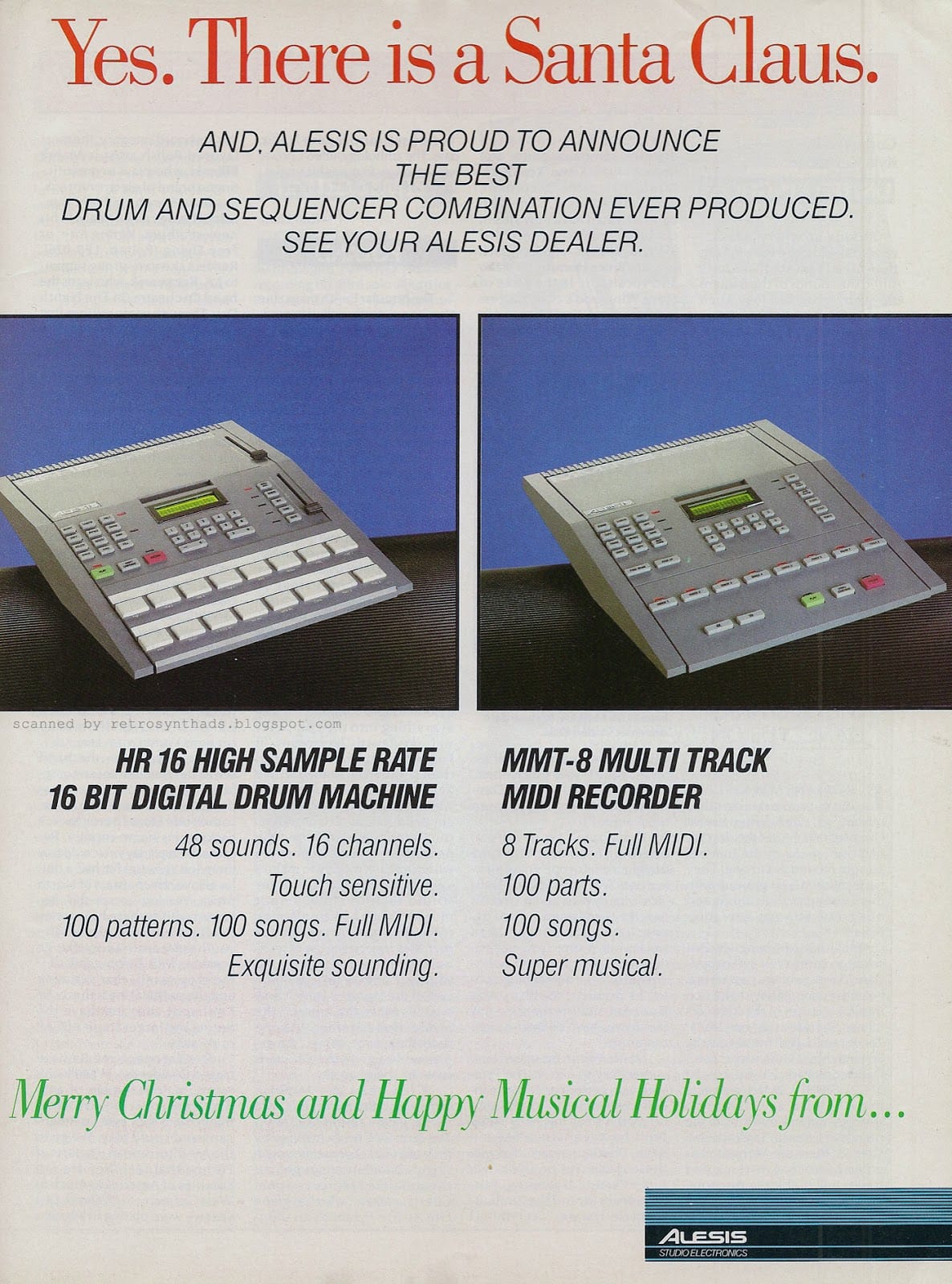
Lately I've been digging an old school piece of hardware that probably sounds the least likely to fall into this category. The Alesis MMT-8 is technically not a sequencer, but an 8-channel MIDI "recorder" and playback machine. It really does work a lot like an 8-track tape machine, but with MIDI data instead of audio. That means that it can control up to 8 devices by either playing notes, triggering their own sequencers, sending program change, and transmitting CC data. It's become the central master of my setup, and though it has its faults, it's so refreshing to get away from the computer for real that I'm itching to get on with writing new music.

It's a strange design that could only come out of the late 80s, like Knight Rider. It shares the lazer-zap shape with its brother the HR-16 (precursor to the most successful drum machine of all time, as well as the strange flip-up panel on top that contains an abbreviated user manual. Oddly, that shape does have the advantage of fitting a Korg Volca really nicely.

Alesis MMT-8

The first "issue" with the machine is that it doesn't have a very accurate clock. It's slow by about a whole BPM. If you want to be tempo-accurate, you need something else to send the data. On its own though, it has a pretty solid clock, though it purely transmits what was recorded into it, so if you want some unique feel or timing with "character" you'll need to trigger other sequencers. I'm just dreading when I play a show and someone comes up to me to say "I bet you thought you were playing at 74 bpm but that was really 73." They're out there. I'm sure of it.

The one workflow issue it has is a lack of overdubbing. If, for instance, I want drums and hi hats to be on the same track, I have to play the whole mess at once. Potentially a challenge, and more or less impossible if I want some kind of CC data at the same time. So those have to go on different channels. That being said, I have yet to feel like I need more than 8 channels. And when I do, I'll probably just find another MMT for about a hundred bucks. It does have extremely detailed editing capability as long as you're willing to do it on a 2-line LCD screen with squishy rubber buttons.

It's remarkably fast and intuitive once you're in there, and that has always been the most important thing to me in a creative tool. Get me punching in notes and feeling the song, not thinking about how a thing works. And it's rare to get that along with the immediacy of hardware.

So, Alesis MMT-8, I salute you.

Discuss

Bob Moog and usability heuristics

Here's a rare intersection of my interests. This is actually a great article for UX folks who don't know anything about synthesizers.

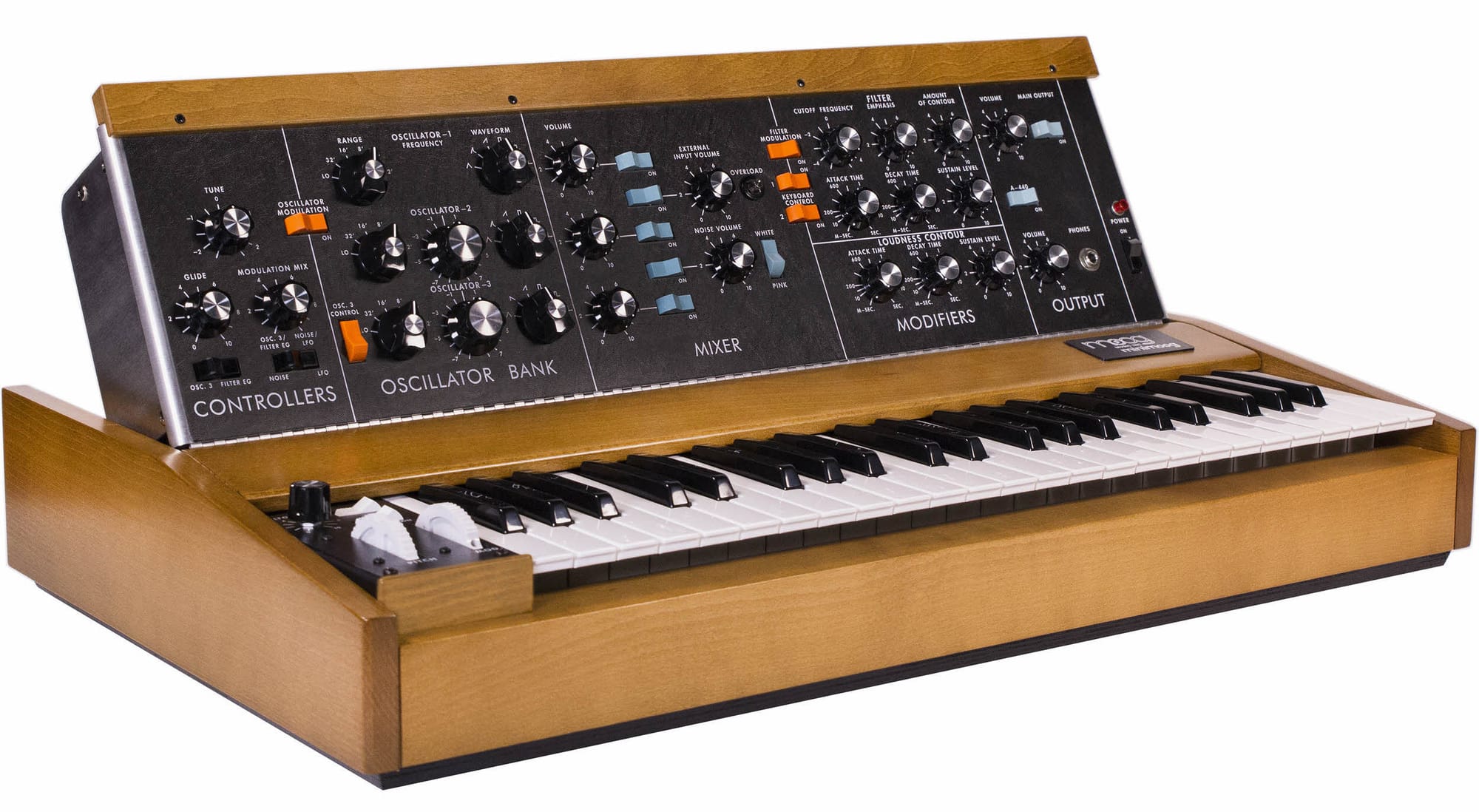
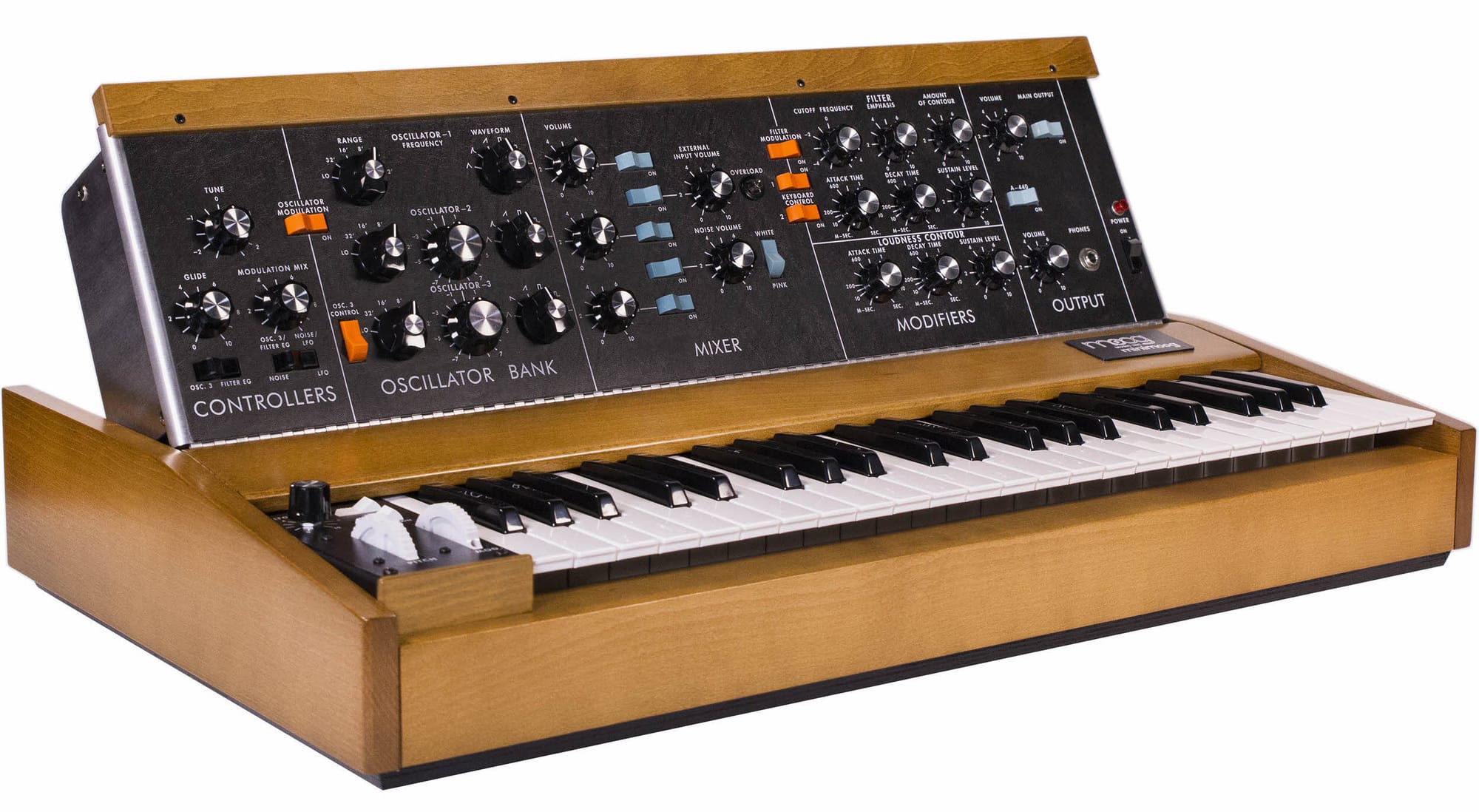
The author makes the (accurate) argument that Bob Moog changed the game by hard-wiring some signal paths and abandoning the fully customizable cable-based routing of modular synths.

This is essentially what Apple did in terms of UI as well that led to their early success:

  1. Preset the red routes.
  2. Enable other routes with some switches that are not part of the main UI.
  3. Just abandon the ability to do some things that most users won't need.

That made Apple popular with artists, designers and musicians, just as the Model D became the first synth truly popular with a wide range of musicians. Sure, the Rick Wakemans (and Linus Torvalds) of the world might want more, but they have their complicated alternatives. For the rest of us, it was finally time to make music with synths. Just watch any gear-focused interview with John Foxx, Gary Numan, George Clinton, Rick Wright, you name it — the Model D hugely influenced their worlds so they could influence the rest of the world.

This philosophy can still be controversial at times, as with GNOME 3 (which, incidentally, has become less loathed in the years since its release), but in general the idea of solving for the 90% of users who don't need 50% of the features is considered an obvious one nowadays.

Of course, modulars have seen a resurgence lately because once you're in deep you inevitably want to start making your own synths. But that hasn't stopped the steady stream of simplistic analog boxes like the Volca series or Behringer's slavish old-school synth imitations. Options are great, but menu diving is no fun and the quickest way to get a musician to love your instrument is to get them creating quickly.

And this, as the article gets across pretty well, is what we should learn from Moog.

Apple would've patented the pitch wheel though.

Discuss

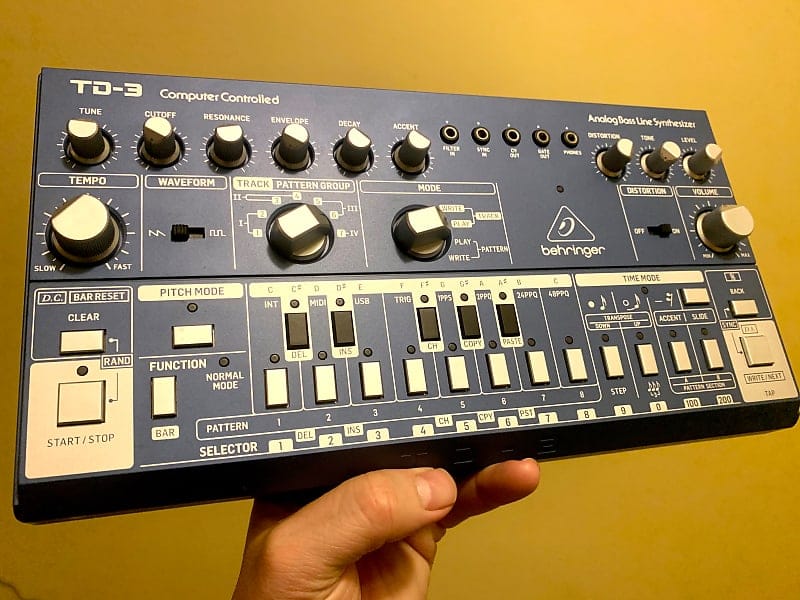
New device: Behringer TD-3

It's pretty safe to call Behringer "much-maligned." Obviously they have a tendency to do the cheap imitation version of gear, and Uli seems like kind of a dick. But rather than Mackie mixers or random pedals, they've set their sights in the past decade on the unobtanium of electronic music stuff. The Minimoog, the ARP 2600, the 808. And one of the recent ones is the Roland TB-303.

I picked one up on Reverb for under $100 shipped, so it's kind of hard to say no. It goes well with my other small, cheap desktop modules like the Volca series and Arturia Microbrute. It is, however, a bit flimsier feeling than the others. But I've been assured by some owners of the original that it was also a plastic box that you wouldn't want to drop from too far up.

Sounds

So how does it sound? There are plenty of YouTube videos at this point, but more than any other piece of synth gear I have, it does One Thing. It does that thing right, though. There are two wave shapes, the saw and square, and simplistic filter controls that were meant for guitarists rather than subtractive synth experts to work. The TB-3 adds a nice distortion option that the 303 lacked, and it really helps the bass cut through a thicker mix. I almost never turn it off, especially on the square wave shape. There's also a little patch bay at the top that lets you do some very basic CV controls. I could probably sync the filter to the kick pattern of the Volca Beats or send gate info to the Microbrute arpeggiator, but I have yet to play with it.

Sequences

The one thing that I almost wish wasn't so authentic is the sequencer. It works by programming notes, then by going back and programming all their lengths, including rests and holds. You really have to plan out your patterns in advance before starting to punch buttons. Fortunately, you can switch the thing into pitch mode and send it notes from somewhere else, like Ableton Live or my Alesis MMT-8 sequencer.

Summary

Those folks who automatically won't buy Behringer aside (I get you), the TB-3 isn't a device for everyone. It only does one thing, and chances are it'll makes you think of acid house as soon as it starts playing. But if you need bass in your setup, you could do a lot worse than around a hundred bucks for something that can shake the floor.

Discuss