All postsEXPLORE TOPIC

#internet

Viva la RSS

A fully soverign feed system - The Universe of Joshua Blais
A blog, notes, gallery, lifestyle and fully conglomerated posts from Joshua.

This is pretty much what I do, though some details are different. I use the Apple ecosystem currently, so rather than Capy (which does sit comfortably on my Boox Palma) I'm using NetNewsWire everywhere, and my backend is FreshRSS instead of Miniflux because I just like it more and it's well-supported.

I don't know why I didn't know this, but YouTube has RSS feeds!! So while RSS has once again become my choice way of "consuming content" on the internet, it's now even better. Coming to YT with the intent of watching subscribed videos and getting sucked into shorts or whatever is absolutely maddening once you realize it's happened, so I just added all those subscriptions into my RSS feeds. Magical. I haven't done any of this wizardry to get them to play in a movie player like MPV, but maybe someday.

Discuss

Alan Lomax's recordings online

Via Open Culture, who apparently posted this ages ago, here is a nearly-complete archive of Alan Lomax's massively important historical field recordings. Used to be, you'd have to wander into some NPR-friendly record store or maybe Barnes & Noble and pick up a CD box set of something like this, lend it to Moby, and never see it again. Well, now you can pop online and search by a few different criteria. It's fascinating.

Discuss

Subvert

While I’m all-in on re-decentralizing the web, there are certain places where putting a lot of the same kind of content together does make sense. For instance, a music store. But that doesn’t mean a profit-driven version of the music industry that’s even worse than the old profit-driven music industry. Yes, I’m talking about Daniel Ek but I’m also talking about Bandcamp, which is somehow doing worse than it was under the Fortnite people.

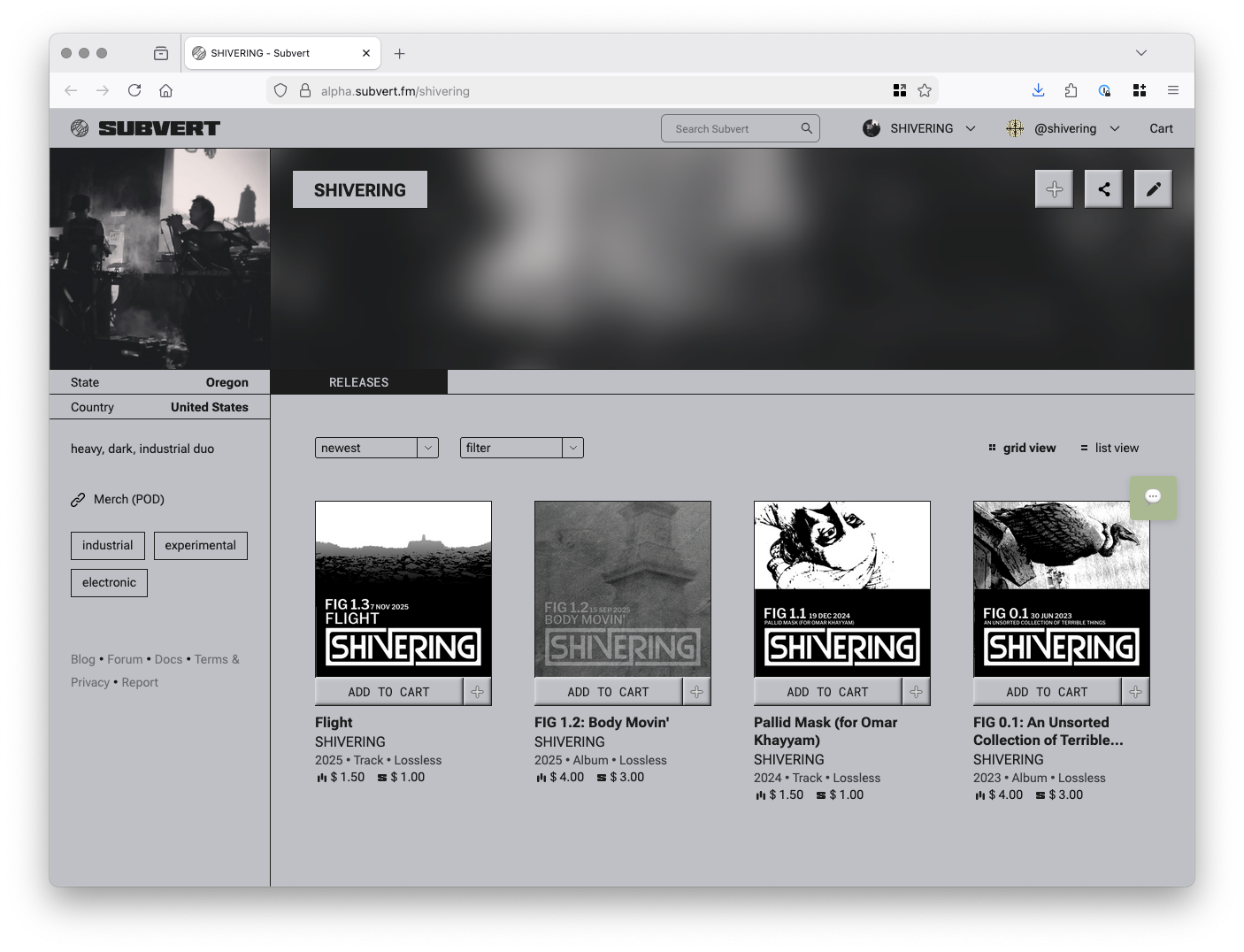
So what would an alternative look like? According to Subvert, it would be a collective. It would build slowly, it wouldn’t require endless growth, and it would have a straight-up manifesto in the form of a zine. They have a pretty solid vision for a musician-owned world of digital presence. This checks way too many of my boxes to just ignore, so I signed up as a founding musician. It's got an interesting old-school aesthetic too.

We now have our music up on the alpha site, and if you're interested in supporting me and our tunes, I'd dig it if you gave that a shot. It's hard to break through the monopolies and duopolies of the current tech world, but I'm cautiously optimistic.

Discuss

Ah, Websites

Remember websites?

Some friends and some people I don't know got together after the brief run of cohost to start a group blog about... stuff? Things? Not sure. But they started with "Websites I have known and loved,", and though many are younger than I am they're old enough to remember the days before the social media takeover of the internet. I think it's a pretty serious bummer that we're so into our own idea of audience that we prefer these walled gardens of garbage and speedy dopamine that we've all but abandoned websites except when we want to look at a restaurant menu (and that's been co-opted by Bezos's GrubHub more than half the time).

Yes, there are exceptions to this: artists who work in the medium. Think of Dril or the second era of webcomics that blossomed before Instagram's algorithms crushed their ability to actually be read. But though it's cheaper and easier than ever to stand up a website, there may never be another zombo.com (miraculously, it has kept up with technology and still works). There will probably never be another rotten.com either, and while you might think that's great, the more "social" online spaces where that kind of stuff is shared are the worst breeding grounds of right-wing, incel, white supremacist, misogynist trash online. Which means I do have to say, I don't think it's all rose-colored. Something Awful was a great place in some ways, but contributed to the caustic way we interact online (and of course Lowtax turned out to be pretty terrible even if he did have ideas about content moderation that we could probably use more of these days).

Though I like to turn to Molly White's speech that I linked earlier, I think "websites" as means of expression will probably remain fringe. I suppose they always were, it's just the rest of the web that's grown.

Pontifus mentions shortwave as something that resembles the internet in some key ways, and that's kind of fun. Like a lot of people, I developed an interest in shortwave via the Conet Project in the late 90s. I doubt I was the first person to start sampling them, but I sure as shit did it right away. I nerded out so hard on it that I even bought a radio. Sitting on my rooftop porch in Bloomfield, Pittsburgh, my friends and I listened to some very random stuff until finally coming across what I believe was probably HM01 out of Cuba. That was a magical moment the likes of which I probably won't have anymore. Would I trade our connected world and the magic thingies in our pockets? I dunno, but I miss not knowing about stuff. I think that's why stuff like the Most Mysterious Song on the Internet resonates so much with people. There are so few mysteries anymore — at least the ones that a layperson can really feel like a part of — and it's great to recapture that feeling of sitting on your roof and hearing the spooky radio voice.

Discuss

A mysterious mystery, no longer mysterious

Here's some good and fun news on a day when we could use it. One of the greatest internet mysteries of the past decade has been solved.

Maybe you've heard it on a podcast, or possibly read about it in a news story from Buzzfeed or NPR. But since 2019, a group of detectives have been trying to track down The most mysterious song on the internet, sometimes shortened to The Mysterious Song or TMS.

The song itself is really good if you ask me — it has a goth/post-punk vibe but a strong and catchy hook in the verse. The singer has that doom and gloom gothic voice that might remind you of other post-punk singers like Ian Curtis, Andrew Eldritch, or Rodney Orpheus. The guitars, likewise, do similar things to Joy Division or Echo and The Bunnymen, but there's a Yamaha DX7 adding some additional textures that bring a 1987-88 vibe to what feels otherwise firmly early-80s.

The saga actually begins much further back, when a German kid recorded the song off the radio in (probably) 1984 but never heard the DJ say what it was. His sister started looking for it online as far back as 2007. Here's a good rundown from a subreddit dedicated to the search, including links to deeper explainers and even redditors obsessing over DX7 patches.

The story continues with a lot of rabbit trails, false starts, and even some obscure Greek post-punk musicians claiming the song and uploading the crappy radio recording to Spotify as their own (sad, really; Statues in Motion turned out to be a good band that a lot of folks in the search enjoyed listening to, but their efforts to co-opt the song kind of taint them). But 3 days ago, a user made a post confirming that the creator of the tune, a German group called FEX, was found. To prove its validity, he added a different recording of it to his post. Turns out, the radio version was just a demo, which is why the German radio station didn't retain the tape — it was their policy to toss demos after playing them.

So now we know: the song is called "Subways of Your Mind" by FEX from Kiel, (West) Germany. We have multiple songs from them and at least one of those is also pretty great. They plan to get back together to make a modern re-recording of the tune.

And that's it. On one hand, I can't help but feel a little sadness at one less mystery in the world (the imagination can always create something cooler than reality, of course). But on the other, these guys who had no idea what was going on for the past 5 years are now going to get their due. And there are more lost tunes to find, even if they're not all as famous as this one.

Discuss

Chappell Roan trying to change the game

A year after Billie Eilish justified her baggy clothing by saying she "didn't want people to have access to [her] body, even visually," Chappell Roan is trying to take things a bit further by asserting that her fans don't own her and that she'll just up and quit if they don't back off.

The fact that she's doing this on TikTok starts to get into the complicated nature of what's going on here. When artists and celebrities are on social media sites and talk so directly to their fans as she does, it exacerbates the parasocial feelings that some fans already have, which were probably initiated by the unique and sometimes explicitly confessional aspects of her music and lyrics. But how else to communicate that she is indeed a person and wants to be treated as one? Hard to unravel. it's similar to Eilish's dilemma about sexualization: how to feel positive about people praising her baggy clothes when she feels there's an element of slut-shaming to it?

Of course there are always the commenters and even music writers who'll say that she knew what she was getting into, that this is fame. But fame these days is a different beast, and you're gonna get it from all sides if you're a young woman (from the girls your music is aimed at because you spoke so directly to them, and from men because uhhh we're creeps). Despite being discovered on YouTube, Roan seems like a pop star who belongs in a pre-social-media era, when her stage name could've been the only thing people knew about her. But in the 2020s, Stan isn't even an outlier anymore.

I don't really have a point, not sure I even have an opinion, but I do feel for these young women. Sure, they wanted fame, but for an artist that usually means "sharing the stuff I make with people," not sharing their entire existence.

Discuss

How all of this works

A former coworker from the blog era was complaining about WordPress recently and it made me think of the bad old days, as WP was getting further and further from god's light, when I struggled more and more with it.

The WordPress problem

I don't like that, as a front-end developer (mostly in the "HTML and CSS" sense, too, not the front end we have today with JavaScript pulling all the weight of applications), I can't really make a WordPress theme. There are ways, such as Timber, to make that happen more easily, but that's yet another dependency and more weight added to an already heavy platform.

That's why I initially moved to Kirby. I think it's tempting when you've used something like Twig to want to have a templating language layer on top of things, but the truth is that Kirby (and Processwire, another CMS I've replaced WP sites with) is incredibly simple and doesn't require actual "PHP Coding." We're talking maybe a bit of logic now and again, but in general the functions are handled by an API that is pretty easy to use. Not to mention that both support the idea of defining your types of content, as opposed to having to bolt on yet more plugins to get custom content types and attributes to go with them.

The reason for all this adding on of functionality that resembles Legos a lot less than it looks like a technological shanty town is that WordPress was built for blogs. And yet!! Even running a simple blog is now handled more easily by other tools like Ghost.

Going static

So here I am, and it's been about a year and a half since I changed engines again, this time to the static generator Eleventy. One thing you really don't get out of the box with a static site generator is the CMS. But what you do get is your Markdown editor of choice. On Mac, that is of course still Byword, and on Linux it is currently the lovely Abricotine, but the repo was archived sometime in the fall so we'll see.

So how does it actually work?

The tools

Here are the requirements in terms of tools and platforms:

  1. Eleventy (the Node script that builds a static site from Markdown files)
  2. Github (for storing the site files, accessing them from anywhere, and controlling deployment)
  3. Netlify with a free plan (for hosting and publishing)

There are a few requirements on the computer side:

  1. Node (easily installed via apt on Debian or homebrew on Mac)
  2. Git (or a GUI Git client, which is what I prefer)
  3. An editor (even Textedit will do, but why not use a nice one?)

But once you install Node, all the other stuff that's needed is stored in the repository itself. Using the simplest boilerplate and reading the docs for a few minutes was all it took for me to make the simple Nunjucks templates required to make a site run efficiently. It could certainly do even more than a blog, but without a CMS interface I wouldn't give it to a freelance client or anything like that (which is where headless CMSes come in).

But for the marginally tech-inclined, it's pretty easy.

How I do it

So what about actually writing?

  1. Make sure the repo is up to date on the local machine using Git.
  2. Create a new text file in your editor of choice.
  3. Add the YAML. Posts in Eleventy are configured using YAML at the top of the document, something that is more and more common these days. All the popular static site makers like Gatsby, Jekyll, and Hugo use it, as do flat-file CMSes like Kirby or Grav. It's not too hard to remember the format, but I use Espanso to store it as a shortcut. You could use TextExpander, aText, or whatever you like here, but Espanso works on both Mac and Linux for zero dollars so I'm into it.
  4. Run the Eleventy local server to see your work. It's a quick Node command and you get a really nice lightweight web server that runs your site locally. Every time you save a file, it automatically rebuilds the site and refreshes the browser.
  5. Check in and push to Git. That's it. Netlify handles the rest, and in a few seconds your site is ready. It's faster and easier than using FTP to update a static site. Images are the only potential problem as binaries can be slow to upload in Git, but I haven't encountered issues yet. We're talking about images on a website, not extremely large files.

However

Is any of this really easier than WordPress or Ghost or whatever? I dunno. It's free, I know that. It lets me write in a nice text or Markdown editor, which I honestly feel more than a web interface or tool like MarsEdit. I've been doing this kind of thing a long time. It makes me feel a bit like a wizard. Plus, it hearkens back to an older, more interesting version of the internet that I used to spend time on before it became the engine that powers the most destructive form of capitalism we've probably ever seen. I guess that counts for something.

Time to go write my next post in Vim.

Discuss

Migration and loss

As this iteration of the blog enters its tenth year (and I believe it's on its third CMS? Fourth?) I've been moving a lot of posts finally from the old Kirby system. It just involves sucking metadata out of the Kirby format and into the frontmatter that Eleventy uses, which is something more portable for the next inevitable move.

But while the process is more manual than I would like, it has given me an opportunity to look at old content. There are some really interesting links I've blogged. Unfortunately, a HUGE chunk of them do not work anymore.

It's hard not to see this as something fundamentally messed up. Like, we've broken the internet somehow.

Discuss