Here's cool video with Tony Visconti discussing the creation of "Heroes," the title song of maybe the best of Bowie's Berlin albums. It's amazing just to hear the multi tracks — Fripp's brilliant feedback guitar, the crack band, and Bowie's vocal takes, which get written about a lot but prove his power when you hear them on their own.
It'd be easy to take away that the era of true studio innovation with giant budgets and beautiful studios is mostly at an end so we'll never get great records like this anymore, but it's all there available to us. You could recreate so many of these things and more in your own house. The inspiration is what's important, and there's a lot of it in this video.
One of the more fun things about playing electronic music is figuring out how to perform live. To some people, Ableton Live and its external controllers made the question moot. And to a large number of others, Elektron’s highly playable devices have become the de facto way of low-impact performance design.
But when you’re not interested in bringing out a computer and you don’t have nice Elektron stuff, creating a way to connect and perform on your equipment is a fun and sometimes ridiculous challenge.
Various Reasons, for me, has always been about this. And usually it’s been a little too complicated and unreliable to make things easy to play. But discovering some of the features of my Alesis Micron has really opened up my options.
What it is
Today, my setup starts with the (non-pro) Arturia BeatStep, which mostly provides master clock but runs the sequence on a couple songs. It’s a fun way to run things because even though I can’t hard-wire a tempo to songs, the analog clock helps me go by “feel” a little bit.
From there, the MIDI chain goes to the Micron, which can run a multi-track sequencer. Unfortunately, having multiple sequences in songs means holding down keys and moving your finger around. That’s fine in some cases, and in others I’ve adapted tunes to use the same bassline moved around in key. There can even be rhythms.
In theory, a whole song can be built on the Micron, but I consider my modded Alesis HR-16 to be a signature part of my sound. So that is next in the chain. The snare runs to a cheap delay pedal to help alter sounds and add dubby effects to the beats. From there, I send MIDI clock to my Arturia Microbrute, which is almost always running an arpeggiator timed to that clock. It goes through a preamp for distortion and a Catalinbread spring reverb.
The last piece is a Korg Volca Keys. I use it for pads, leads, and with the aid of a Hotone Wally looper, transitions between songs for less awkward silence while I change patches. The hardest part of this is hitting keys, but I don’t have a small enough MIDI controller to justify bringing out something else.
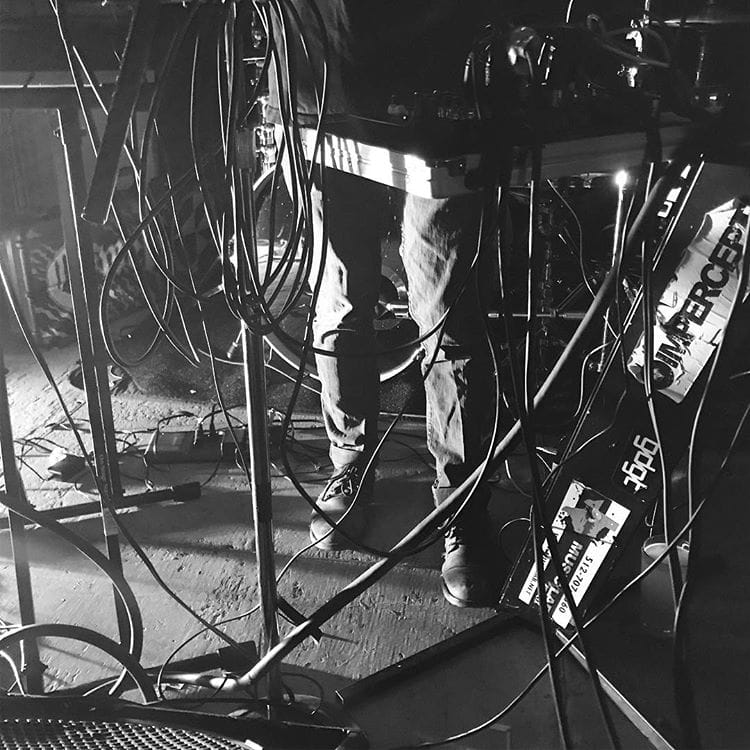
It’s not the simplest setup I have. There are quite a few connections, and a couple analog synths with no patch recall. It does make changing parts within songs much easier than my previous setup, which had me running around like a crazy person trying to change patterns on multiple sequencers — some of which require two fingers. It’s got a bit of a shambolic timing, which is not ideal in some cases, but a lot more interesting and unique than a perfect computer or Octatrack clock. An audience member described it as “raw,” but to excerpt some of the lyrics, it’s also a mess of tangled wires.
In the quest for audio perfection, I've found myself trying yet another tool.
This time it was thanks to a mastering project — at the end of the day I still ended up doing mastering in DSP-Quattro, an unreliable piece of software that nevertheless is a dedicated mastering DAW. When you need things like crossfades, effects on regions, and DDP export... you need them. It's another 300 bucks to upgrade Studio One to the version that has a mastering workflow, so guess who isn't doing that? I'm continually frustrated by DSP-Quattro's odd workflows and constant crashing, but it does the job eventually.
In the meantime, though, I gave REAPER a shot at it. If you're not familiar, Reaper (it's an acronym but I get really tired of capitalizing it) is a constantly-developing DAW that carries a $60 price tag for amateurs and $225 for pros. My impression of Reaper has always been that it's a technician's tool or "computer person" version of a DAW. That is to say, kind of the opposite of Pro Tools's heavy mimicry of a console-based workflow. One thing that its proponents are always fond of pimping is the customization. Reaper can, within reason, work any way you want it to, but there's a massive learning and setup curve to get there.
Or maybe not. Turns out, it isn't that hard to do a lot of the customizations that force Reaper to work the way you want to work, from tool behavior to making F3 toggle the mixer like Pro Tools.
It also sounds at least as good as Studio One, and has a much cleaner, more native-feeling interface than it used to. And I think that the the "computer-like" focus of the UI as opposed to slavish console worship is actually a strength. There are no audio or MIDI tracks, just tracks, and there are no groups, VCAs, or busses. Every track can be anything, so it supports an "as you go" creative workflow. Takes and playlists work easily.
The shortcoming that most DAWs run up against versus Pro Tools is always audio editing, so that remains to be seen.
I'm going to continue any client work that comes along in Studio One, but try the next An Empty Room recording with Reaper and see how it goes.
Rachel Andrew, the Guru of Grids, on why you don't need a "Grid Framework" to use CSS Grid. For me, part of the desire to use grid is right here — the additional overhead of throwing in a grid system is just unnecessary. And with Grid comes horizontal and vertical alignment, markup without containers, and so many more possibilities for layout.
Even fallbacks, one reason frameworks tend to get popular, aren't needed in her estimation:
Create solid markup, uncluttered by additional elements that the past tells you that you need. Design your site using what Grid and other new methods have to offer. Then look at how you deal with the browsers without support, by serving them something slightly simpler.
Now that Edge fully supports Grid, it's probably time to stop farting around and really learn it, now that I've finally embraced flexbox.
Maybe the "golden age of UX" really is over. I think a better way to put it is that we've been discovered out here in our clubhouse and now we're gonna have to grow up and play ball with everyone else. But this widely-shared article from Marvel (a tool I like a lot) has missed the mark in a couple fundamental ways.
First, strategy is not for everyone. We did what I think is a great job designing strategy at D&B, and it was in itself a design challenge. But not everyone on the team was involved or wanted to be involved. Disparaging non-strategic UX as a "production" role is an insulting mistake. This is skilled practitioner stuff, and there are still very few people who are actually good at it. The fact that there are exponentially more UX designers out there doesn't mean there are infinitely more good ones, especially since new folks are being raised on hot takes. So trying to convince the relatively few good ones to move on to strategic roles in companies that still need their user advocacy is not gonna help those companies.
Especially if your next aim is to get those designers on the growth or marketing trains.
"Growth hacking" is what UX designers are destined for now? Or social media marketing? Turn me into glue now, then, thanks. UX efforts are necessary in all of these worlds, and product marketing is inextricably tied to product design — but the core tenets of UX are unaffected by Valley trends (like "growth hacking") or marketing efforts, which are famous for attempting to subvert the true needs of the user.
Let's not lose the voice of the user in an attempt to stay relevant to a fad-driven Product Hunting world. And if the going wisdom is "we solved that, time to move the talented designers on to growth hacking and marketing," then I'd consider that all the more reason why UX is still badly needed on the ground.
I think the article itself disproves the thesis that Mistral is patently hateable— in fact the piece eased my own distaste for it. I am plenty old enough to remember a time before Comic Sans and Papyrus when Mistral was the only typeface to loathe.
One point that I think is key is that it was one of the few extant fonts, let alone ones that business owners had access to, that would approximate handwriting or graffiti. It's a big reason Comic Sans persists, and presumably why sites like Creative Market are flooded with handwritten custom typefaces. I find it hard to hate on small business owners who wanted their signs or truck stickers to be less brutalist. A world where an otherwise solid piece of art like Straight Outta Compton can be packaged in crap design is a more fun world, anyway.
Mall is a capable, arguably influential designer and writer on the web. It's always cool to see how the sausage is made, but even cooler to see that a person with his credentials has a framework for creative "theft" as a basis for starting new designs.
When you're experienced, you start to internalize these kinds of layout patterns. But while recently working on a website, I realized I hadn't designed one in a very long time and was pretty unfamiliar with the nuts and bolts of a site these days. This would've been a great way to get rolling, and I might try it for the next iteration.
Just kidding, this article didn't really use that word. And rather than an alarmist view, this is a fairly measured take. However, most of the arguments are actually against realtime (onblur) validation, not inline validation.
I spent two years dealing with some serious problems that were born entirely out of the fact that an application used realtime+inline validation. And that was primarily in a series of wizard-like dialogs, which really didn't make any sense (the pattern of "disable the continue button until validation is cleared" would've worked well).
Our problems included:
forms that didn't require a certain order to filling them out, but validation that did
false positives triggered by mouse actions that left users in an unresolvable state if they clicked "wrong"
field groups often in a false-positive state (point #4 in the article)
This isn't the same as saying that per-field validation is wrong, and I still strongly believe in that, but this article has a lot of solid points.
Some great fundamentals here. Other than the wide trend toward cranking the size that's been going on for a few years, really solid type work on the web is only recently coming into its own. It's kind of like when Khoi Vinh popularized grids a few years back; it made me wonder how many folks in this business have even studied design. I think it's great when people with more formal knowledge spread it to the web.
When it comes to type though, it's only been recently that we've been able to have a real level of control over it.