I suppose I was fortunate, really. My band's drummer, who also wrote maybe 70% of the guitar riffs, finished his PhD and left the country to go work in Switzerland. Writing out that sentence makes me realize he was the really fortunate one. But what I mean is, a lot of my musician friends had to deal with the fact that they couldn't get together during the pandemic. For better or worse, I didn't have a band anymore to worry about. Fortunately, prior to 2020 I'd released about a dozen releases (between digital, CD and cassette) over the past 20 years that featured no other musicians but me. So I started to hit the shed.
I've been a process musician for most of that time. Each project, each release, is the result of a way of working. It comes from being in the experimental world for so long. Now, even when I make something that I find enjoyable to listen to, it's still gonna be made via a specific process. And when I make something with that process, I tend to move on. But that kind of indulgence is tough for someone with kids and a day job. Movement doesn't happen quickly enough, and output is minimal.
So I came up with the plan of forcing myself into the shed once a week, and I decided I wasn't going to come out of the shed until I had a finished song. Talking it out with a friend, I realized this accomplishes a few things:
It opens the throttle on that speed of progress. If you just "play around" once a week for a couple hours, you're not going to get anywhere for a long time. Validating an idea once a week gets you through the ruts and the familiar patterns and into new ideas sooner.
It keeps you from being precious about polish and "finish." The dumb truth of a piece of music or art is that it's finished when you say it is. Bee Thousand is just as "finished" as Dark Side of the Moon, and they're both classics of their space. One was made by a group of guys with infinite time and money, and the other was made by a drunk schoolteacher with kids.
It makes you go with your gut. Maybe if I hadn't been doing this for close to 25 years, I wouldn't feel like the gut was a useful thing. But the gut has become experienced.
I'm currently using this process to create new Various Reasons tunes, always with the further constraint that someday they can be recreated live, but the first work I did with a "live band" style and put onto Bandcamp as Mezzo Cortex.
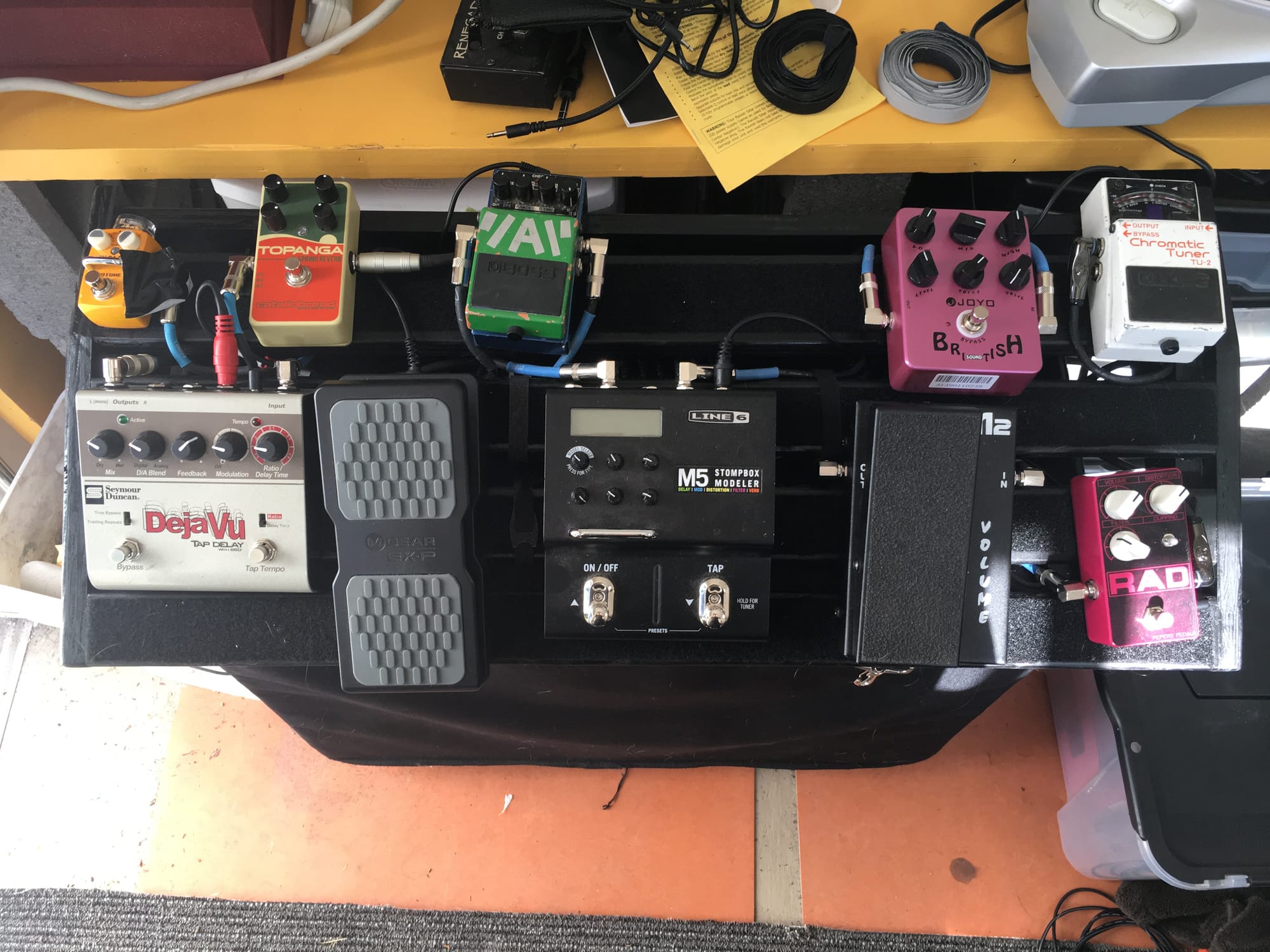
Like any mediocre guitarist, I spend a lot of time rethinking my tone and my pedalboard. Like any experimental musician who likes to turn guitars into other sounds, I spend a lot of time trying to balance versatility and ease of use. Nobody likes to tap dance one-footed, even if you can perform an entire symphony.
Over the course of the last year, I've really landed on a layout that I like. In order of the signal chain, here it is.
Boss TU-2
Not much to say about this. Fancy tuners come around every once in a while, but for accuracy, visibility, and durability, it's hard to beat the classic Boss.
Pepers Pedals RAD
This is a Rat pedal. Pretty simple. It's made by Tony Pepers in New Zealand, and when you buy his pedals they come with this amazing gummy candy that's only available there. There are standard Rat controls and a switch that changes the clipping mode from standard Rat to Turbo Rat, or removes the clipping altogether. Without clipping, it's decidedly less Rat-like but it's still a very hairy fuzz. I don't stack overdrives and distortions anymore. I just crank up a Rat.
Morley Mini Volume
I love the size of this thing. I always put volume pedals after the distortion, even though I sometimes can't get total silence with it rocked down, because that way the tone doesn't change when I fade it up and down. I do waffle on whether to put it in front of or behind my preamp pedal.
Joyo British Sound
Yes, this is 100% a ripoff, possibly a stolen board design, of the Tech 21 British pedal, and it's probably unethical to buy this or any Joyo pedal because even the original designs have been more or less funded by this kind of stuff. But damn, it cost me $20 and it helps add that throaty, low-midrange roar to my plain sounding solid state amp. Plus I can dial in just the right amount of gain so that even the clean tone has a tiny bit of breakup. That helps make my cleans a little softer on the attack and less obviously solid-state.
Line 6 M5
Line 6 is not exactly the most prestigious brand to put on your board, but this pedal is ridiculously useful for keeping said board from getting completely out of hand. I use it primarily for modulation and special effects. I currently use the M5 for the pitch detune effect at the end of "We Are The Life of the Future," and for wah/filter during "We Live Inside." Both of these use the M-Audio expression pedal that's plugged into it (another not-great brand but it's lasted longer than the Roland one I used to have). Beyond the tremolos, choruses, flangers and other modulators, there are some fun (if not super useful) synth sounds and other random effects. Any effect can have its settings changed with the expression, which makes it doubly useful. And it's true-bypass, so even if you're worried about Patented Line 6 Tone altering your signal, it's alright. Personally, I would never use the preamp and distortion sounds, they're just not that good, but for single-use sounds you don't want to add a whole pedal for... why not?
Seymour Duncan Deja Vu
This is a little-known delay with a hugely useful feature set and a great, live-friendly layout. There's tap tempo that can be set to either delay at the exact tempo you press, or at measure divisions, e.g. you tap the quarter note but it'll delay on a dotted eighth. It has an analog circuit simulator (cuts a lot of highs out of the repeats) with variable modulation (warble, basically) and you can dial any combination between the digital and analog for a lot of tonal variation. You can switch between tails or true bypass (I usually leave tails on and it doesn't really suck tone at all). As a bonus, cranking the delay speed knob way over will give you a looper function.
As if all that wasn't enough, you can plug a TRS into its "insert" jack and put a whole chain of effects there that will only effect the repeats. That's what the Boss PS-2 is doing there: adding either compounding delays or pitch shifts to the repeats. Insane possibilities.
It's basically the best delay pedal I've ever used, and the right combination of simple and powerful.
Catalinbread Topanga
I switch reverbs out sometimes but this one is too fun to leave at home. It's supposed to be an emulation of a Fender spring reverb unit. Yes, you can get some super wet Dick Dale sounds out of it. One of its more enjoyable features is that it's sensitive to volume and creates breakup as you feed it a louder signal. Made in Portland.
Hotone Wally
I may never figure out how to pronounce Hotone, but the Wally is a great little looper. You can stack a lot of loops of different times, you can change their pitch after you've recorded, and change the output volume of the playback. Great features for a tiny pedal. Unfortunately with its single button it's complicated to control and you can't end a loop at an exact time. And believe it or not, for most boards it's actually a little too small. I can't manage to get enough Velcro on the thing to keep it from moving around, and there's nowhere to zip-tie it.
TC Voicelive (not pictured)
The empty space usually has my vocal processor on it. This thing is basically just delays, but it has some sort of compression and possibly EQ in it because everything comes out of it sounding so polished. It was purchased by my bandmate from Mike Scheidt, so it's seen some action but it's really tough. Unlike many other vocal effects I've used, sound people do not hate it.
The Board
The board itself is a handmade wooden job that a friend built at a custom size for a pretty meager amount of money. I painted and velcro'd it, and even though it doesn't have a case and the slats can be a bit weird for the odd form-factor pedals like the Deja Vu, it's solid and really does the trick. The power supply is hidden out of sight and I have been able to velcro-tie the extra cabling. I just need to get an angled plug into that Topanga...
Most UX researchers will parrot the line that focus groups are terrible, and even if they are parroting, they're right. Erika Hall, in Just Enough Research, calls focus groups "research theater."
But often, you'll find that budget and/or time constraints can manipulate your beautifully planned user research into a focus group. Is there anything you can do about it?
As usual, Pentagram and other gatekeeping haters be damned, design thinking (or human-centered design) comes to the rescue. Co-design doesn't just mean working in cross-functional teams in your own organization, it means involving your users. If we truly believe that they know best, then why not involve them?
About a year ago, I got access to a group of young people who were acting as an advisory board to a client. The client made e-learning modules for an urban teen market and we were building the interface and helping with their product design philosophy. The problem with this access was that not only were the kids biased — they had volunteered for the position and were paid a stipend — but when they got together they were effectively a focus group. All of them were smart and motivated, but they weren't always motivated to give the kind of feedback we needed, and we continued to see patterns of one person leading the group (a standard focus group behavior).
Since we met them regularly, I started to give them homework. They put together mood boards and talked about the kinds of sites they regularly visited. Maybe they all colluded, but it didn't matter quite as much because it was an intentional collaboration on their part in this case.
Then we eased into some design thinking exercises, and conducted a design studio workshop. I instructed them to think of the particular details of what made them frustrated with, apathetic to, or unable to operate the current layouts. Then they drew. Standard practice applies here:
We were remote, but I instructed the moderators to give them sharpies so we didn't fall into the detailed drawing trap.
The youth liaison to the company, as well as the product leader and another product manager, participated.
The drawings were timeboxed, then presented and lightly critiqued as a group.
They took pictures and sent them to us, and we did affinity mapping and more detailed analysis after the workshop.
None of this is really rocket surgery, but it's worth mentioning that as long as you have the right participants, any user research should be considered useful and there's a lot of value in being able to "make lemonade."
This one is tough. Mark Hollis recently passed, and that was difficult to process but in the musical sense he was already gone, having left a near-perfect legacy of forward-thinking avant-pop that to most people's minds invented post-rock.
Scott Walker on the other hand, despite his age, was still fairly prolific, especially considering his attention to craft and detail.
I can think of at least 4 moments where he defied expectations: Quitting teen idoldom to write music, Scott 4, his songs on Nite Flights, and Climate of Hunter, which really established the rest of his career. There was nothing else on earth like them. There was nobody on earth like him. And there never will be.
Khoi Vinh, a voice of reason, finally weighs in on the debate with "In Defense of Design Thinking, Which Is Terrible." Apparently he also thinks that most of the arguments against design thinking are anti-democratization.
So when I consider design thinking, it matters less to me whether it leads to a lot of bad design or not. What matters to me is whether it helps broaden the language of design, if it helps expand the community of design, if it helps build a world that values and understands design better than it does today. If design thinking is making us more relevant to the world at large, leading non-designers to embrace the way designers think, then the net effect strikes me as positive.
I think the headline is bait and the sentiment is a little radical — as someone who's been working with more behavioral-based personas for a long time, I'd say there's plenty of use personas still have as a design tool. It's just that people, especially marketers, have been using them poorly for years.
However, Microsoft's inclusive "persona spectrum" idea is great. It helps to demonstrate that accessibility and inclusion aren't just about (for instance) serving blind users, they're about serving everyone in as many cases as we can.
Following up on all the bad takes on design thinking (some of which they published), Fast Co has a small interview with an IDEO partner about why everyone suddenly hates design thinking. Short answer: it's just a tool, and one that looks shiny enough that there are tons of people using it poorly.
This article came out early last year, but PURE is a new-to-me usability evaluation method from Intel Security and the master of UX metrics, Jeff Sauro. I'm always looking for low-impact, low-cost ways of evaluating the usability of features before (or, god forbid, in lieu of) a full moderated test.
In some cases, that can be done. Even if you're against the idea as a useful method on its own, it can point to the places that need to have full testing done on them. PURE is nice because a decently-trained person can do it without having to hold tons of heuristic guidelines in their head. And you get a pretty nice-looking chart result at the end.
I've created a spreadsheet that calculates up the scores, and some Figma components to build the chart. I think this might be the case I've been looking for to develop a tool for Figma using their API.